09/09/2026 | News
Formalization Workshop: Dialogue and Practical Tools to Advance Responsible Mining
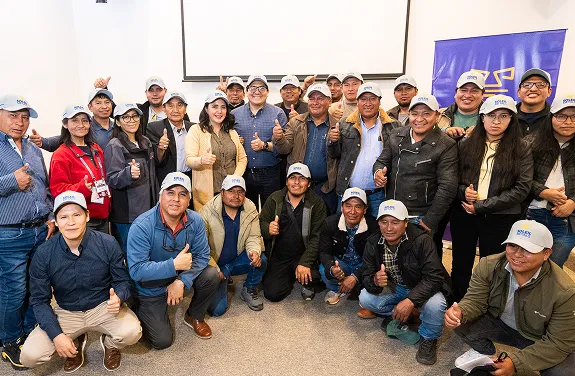
Soleil Metals and Swiss Better Gold held a mining formalization workshop in Cusco for producers link
 Soleil Metals
Formalization, traceability, and due diligence are key to integrating artisanal and small-scale mining into more transparent and competitive supply chains
Cusco, September 2026. — The need to move toward a more transparent and traceable gold supply chain was one of the topics addressed during Qosqo Minero 2026, where Iván Salas, General Manager of Soleil Metals, spoke as a panelist with the presentation “Responsible Gold: From the Value of the Metal to the Value of Origin.”
During his talk, Salas noted that talking about responsible gold means looking beyond the metal itself and focusing on its origin, the conditions under which it was produced, and the ability to verify each stage of the supply chain.
“The value of gold isn’t only in the metal, but also in the story we can prove behind it: its origin, who produced it, and under what conditions it reached the market. Traceability and due diligence let us turn that story into verifiable information,” said Iván Salas during his participation in Qosqo Minero.
What does responsible gold really mean?
The concept of responsible gold is becoming increasingly relevant amid new demands from international markets. For artisanal and small-scale mining (ASM), moving in this direction means facing challenges such as formalization, mineral traceability, risk management, and the adoption of better environmental, social, and governance practices.
In this context, responsibility doesn’t begin once the gold reaches the market. It starts at the source, with the ability to know who produces the mineral, where the operation is located, under what conditions it operates, and how that mineral enters the supply chain.
Traceability thus becomes a fundamental tool. It generates verifiable information about the mineral’s journey and strengthens trust among producers, buyers, processors, refineries, and international markets.
Technology to know and verify origin
The adoption of technology is playing an increasingly important role in these processes. Traceability systems, artificial intelligence, remote sensing, and geochemical analysis can complement traditional verification mechanisms and contribute to more efficient risk management.
At Soleil Metals, these mechanisms are part of a due diligence model based on the OECD Guidance, which includes risk assessment both by geographic area and by mining supplier.
The goal is to move from a model based solely on declarations and documentation to one that combines information, technology, and verification to better understand the mineral’s origin and manage potential risks throughout the chain.
Formalization as a gateway to markets
Formalization is another fundamental element in moving toward responsible gold mining. More than an administrative requirement, it represents an opportunity for producers to integrate into formal supply chains and access markets that demand higher levels of transparency and compliance.
Along these lines, international standards are progressively raising the bar for supply chain actors. Under the Swiss Better Gold (SBG) program, Soleil Metals has completed Step One, which includes a series of commitments aimed at strengthening responsible sourcing and due diligence processes.
This type of initiative brings greater documentation requirements, mineral origin verification processes, and a more rigorous assessment of the risks associated with the supply chain.
Toward a new model of responsible mining
The challenge for Peru is to move toward a model that combines formalization, responsibility, and economic viability. To achieve this, producers, companies, authorities, and specialized organizations will need to work toward common goals, and the regulatory framework will need to keep pace with the sector’s evolution and new international market conditions.
In this scenario, technology and economic efficiency can play a decisive role. The ability to automate processes, analyze information, and improve control mechanisms can help make the adoption of higher standards viable for smaller-scale producers as well.
This vision aligns with international initiatives aimed at strengthening ASM. Recently, the World Gold Council and OCIM signed a Memorandum of Understanding to drive collective action toward more responsible artisanal and small-scale gold mining, with an emphasis on formalization, traceability, responsible processing plants, and market access.
For Salas, the challenge isn’t only about producing more gold, but about creating the conditions for Peruvian gold to demonstrate its origin and compete in markets that increasingly value transparency and trust.
“The future of Peruvian gold doesn’t depend only on how much we produce, but on how much we can prove about its origin. Trust is built when the chain is traceable, verifiable, and responsible from the very first link,” concluded Iván Salas.